American Spinning Works American Spinning Works We bring solutions
Yu-Pima Cotton Initiative
Investment Teaser · 2026
Cotton field in the American Southwest

American Spinning Works — We bring solutions

The missing link in American cotton

Grow here. Spin here.

A first-of-its-kind western U.S. ring-spinning facility designed to turn American Pima cotton into premium domestic yarn — while keeping the jobs, value, and supply-chain resilience at home.

Yuma, Arizona Foreign Trade Zone 219 200+ projected jobs
87%

of U.S. cotton fiber is spun offshore

0

western U.S. ring-spun yarn mills today

$4.40–4.60/lb

delivered premium Supima domestic target

18.2%

Yuma unemployment in August 2025

Investment thesis

Capture the value we export.

America already grows the raw material. Yu-Pima adds the missing conversion step that transforms commodity fiber into premium yarn — close to farms, logistics, labor, and domestic buyers.

One bale. More value at home.

A 480-pound bale valued around $345 can yield roughly 410–430 pounds of premium ring-spun yarn worth approximately $1,850–$1,950.

Raw fiber
67–72¢/lb Approx. 480-pound bale
Yuma conversion
Ring-spun Premium domestic yarn
Finished output
$1.85–1.95K Indicative yarn value
Location advantage

Why Yuma wins.

A manufacturing location positioned at the intersection of competitive power, western logistics, eligible economic-development programs, and cotton-country proximity.

01 / Power

14.1¢/kWh

Arizona versus 30.1¢/kWh in California — a meaningful edge for energy-intensive spinning.

02 / Logistics

Connected west

I-8 and the Union Pacific Sunset Route, approximately 269 miles from Los Angeles.

03 / Trade

FTZ #219

Foreign Trade Zone access can support duty deferral and supply-chain flexibility.

04 / Market gap

First mover

No ring-spun capacity currently operates in the western United States.

Investor comparison

The status quo vs. the Yuma loop.

A clearer view of where value goes today — and how a domestic spinning hub changes the economics, distance, jobs, and control of the supply chain.

Diagram comparing the offshore cotton value chain with a domestic value loop
Supply-chain visual

Close the loop on American soil.

The proposed facility connects domestic fiber to domestic yarn before the product moves into fabric and finished goods.

Chart comparing fiber and electricity costs
Operating-cost evidence

Power changes the math.

For an energy-intensive spinning operation, Arizona's indicative electricity rate creates a substantial structural advantage over California.

≈53%lower indicative power rate
Map comparing textile supply-chain routes and landed costs
Logistics evidence

A western route built for buyers.

Yuma links I-8, the Union Pacific Sunset Route, FTZ #219, cotton regions, and the Los Angeles market in one western operating base.

269 miapproximately to Los Angeles
Investment metric
Status quo / benchmark
Yu-Pima case
Advantage
Indicative electricity rate
California · 30.1¢/kWh
Arizona · 14.1¢/kWh
≈53% lower
Value represented by one bale
Raw fiber · ≈$345
Premium yarn · $1,850–1,950
5.4–5.7×
Western U.S. ring-spun capacity
Current mills · 0
Yu-Pima · first planned facility
First mover
Capital strategy

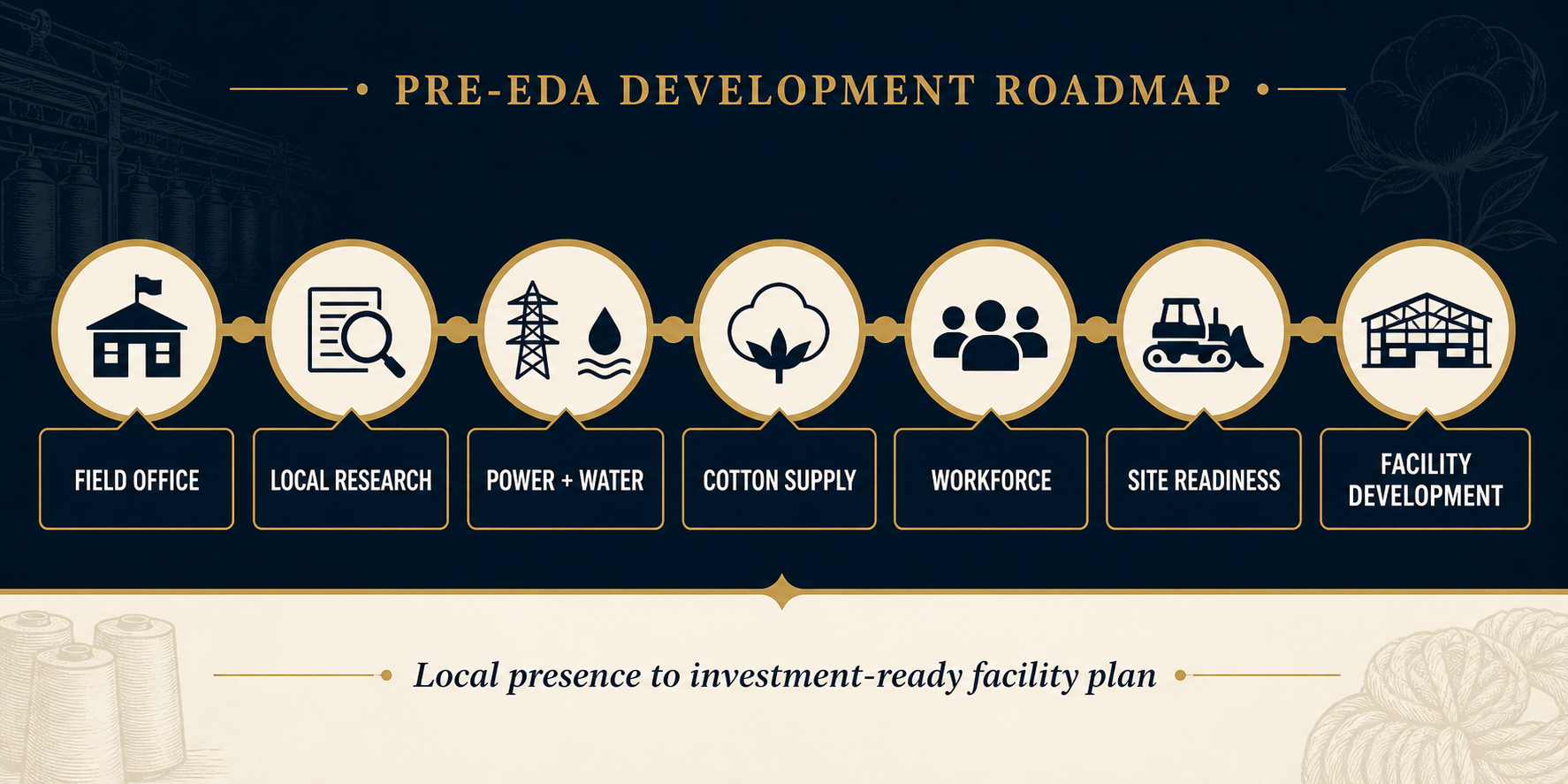
A disciplined three-phase build.

The proposed sequence de-risks the opportunity in stages: prove the plan, build the productive asset, then scale the workforce around it.

Phase 01 · Planning
$1.1–6.5M

Validate + capitalize

Complete feasibility and market studies and capitalize a revolving loan fund.

Potential tracks: EAA · RLF · Recompete
Phase 02 · Infrastructure
$1.5–5M

Build + connect

Develop the spinning facility plus road, utility, and potential rail-spur improvements.

Potential track: Public Works · 200+ projected jobs
Phase 03 · Workforce
$21–46M

Train + scale

Build job pathways with the University of Arizona–Yuma and Arizona Western College.

Potential tracks: Recompete · Good Jobs · STEM
Built as a coalition

Industry, education, and place — aligned.

Led by Daniel S. Lee, President of Fashion Color, Inc. / One Textile Co., with a working coalition spanning regional development, cotton, ginning, education, textile manufacturing, and brand demand.

Greater Yuma EDC University of Arizona–Yuma Arizona Western College Arizona Cotton Growers Association Trucott Supima Corporation LA Textile Association Polo Ralph Lauren
AMERICAN SPINNING WORKS
We bring solutions